
“While the origins of hula may be shrouded in mystery,
they are always entwined with matters of the spirit. ”
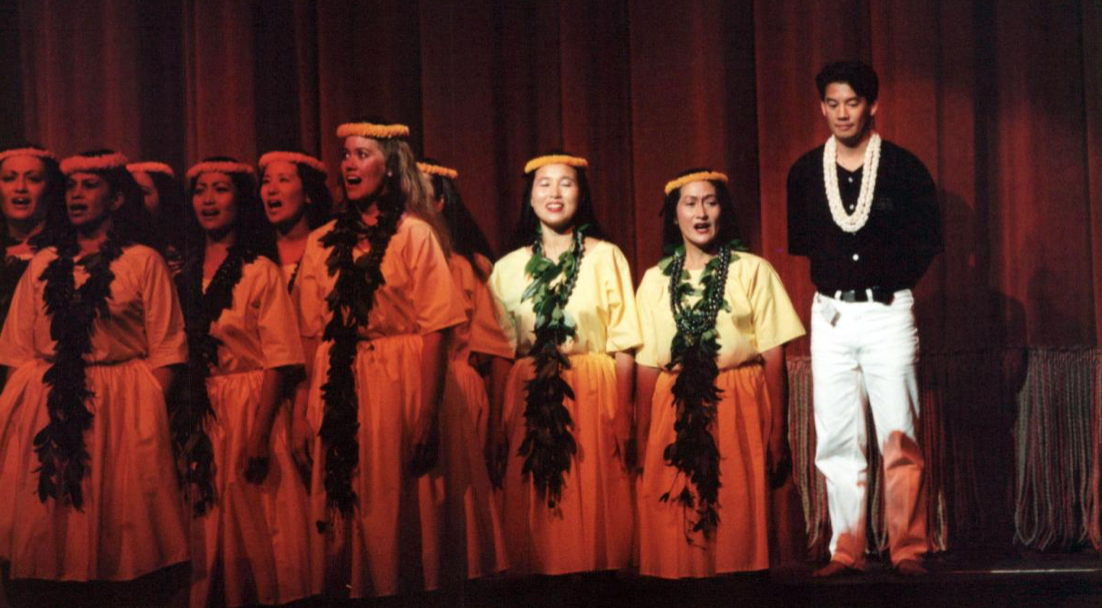
Itʻs hard to imagine that 40 years have passed since my Kumu Michael Pili Pang began his hālau in the uplands of Waimea on Hawaii Island. I started studying with him 38 years ago in 1988.
My husband and I had just moved to Waimea from Venice Beach, California where we had lived for a year. I wanted to be closer to my father who had just suffered a heart attack.
At 3,000 feet elevation, Waimea is cooler than most of Hawaii, with gentle rolling puʻu (hills) and pasturelands. Our new home sat at the foot of majestic Mauna Kea. Sunrise and sunset on the mountain always took my breath away.
Almost immediately, I looked for a hula teacher. I met Michael – he was in his mid-20ʻs - and asked him who his teacher was. He said Maiki Aiu Lake. I didn’t know her or many other hula teachers for that matter and I liked him. It also felt right because classes were held at Kuhio Hale, just five minutes from our new home.
I enjoyed his beginner class. About a month after starting the class, he invited me to attend the kahiko class. During that first kahiko class, I remember sitting and watching while six women in white muslin skirts danced to Kumu Michaelʻs chanting No Luna i Ka Hale Kai (among others) to the rhythm of his ipu-heke. It is one of the oldest hulas in our repertoire.
I was mesmerized. by the beauty of the chanting and the dancing. There was something about their hula that took me to another place. It was simple yet elegant, grounded and subtly radiant!
It naturally became my practice. No matter what I was doing – whether I was working in Hilo or Kona or Honolulu or even Kauai where I helped during the reconstruction after Hurricane Iniki - I would make it a point to attend class. It was a solid commitment.
It is said that Hula can be a jealous mistress. I worked full time, but I limited distractions, and instead made hula a priority. When my kumu wasn’t satisfied with our performance, he didn’t hold back his frustration. He was a fierce guardian of his hula lineage.
I received that as strong encouragement to study and practice even harder. My hula sisters and I practiced hula over and over again. The dance and its meaning became etched into our bodies.
And that is how the lineage has moved from our ancestors to us in this place and time. I had, do, and will always have deep gratitude for my kumu and this practice of grace, fierce compassion and wisdom.
Malama pono (take care of body, mind and heart),
June Kaililani Ryushin Tanoue
Kumu Hula, Roshi
P.S. Recently at our Zen Life & Meditation Center:
2025 ZLMC Year in Photos: https://youtu.be/i0N2zhelWew
Patrick Ungo OʻShea - the Monastery We Live In https://youtu.be/UmcOsnoxV5E
Rev Dan Taigen Leighton https://youtu.be/HnrnNVp8KfY
Ericka Mencken-Trevino "AI and Mindfulness https://youtu.be/llLenivIOEc