
““He aliʻi ka ʻāina; he kauwā ke kanaka.”
The land is a chief; man is its servant.
”
To walk through Morton Arboretum in spring is to understand, in your bones, that the land is chief.
“Stop the car!” I exclaimed to my husband as we drove slowly along a one lane highway past Magnolia Lane in the magnificent Morton Arboretum in Lisle, Illinois. I jumped out to take photos of the huge plum tree with white blossoms all over it. Another smaller tree with pink plum blossoms on branches with tiny matching red leaves also caught catches my eye. Bees were busy buzzing around them collecting pollen.
Divine magenta pink magnolias werejust starting to bloom. Their giant blossoms perched gallantly on tiny branches. I even saw light yellow magnolias covering an entire huge tree!
We drove down to Spruce grove which really feels like a cathedral. The grove is comprised of many tall Spruce trees with bare trunks ending with branches of needles at the very top. There’s an energy in that grove that feels sacred. Spruce is a major producer of timber for construction and for paper pulp. It is the standard material of the soundboards of stringed instruments like acoustic guitars.
We sat on a bench inside the spruce cathedral. Birdsong was everywhere: Nashville warbler, red-bellied woodpecker, white-breasted nuthatch, yellow-rumped warbler, American goldfinch, Blue Jay, Northern cardinal, Black-capped chickadee and an American robin! I caught a glimpse of the woodpecker with its bright red cheery head against the bark of a tree.
A wonder and wealth of indigenous wild plants greeted me. May apples, also known as wild mandrake, looked like umbrellas for gnomes with their huge green leaves about 6 inches above the ground. Virginia creepers were growing up the sides of some of the spruce trees. The delicate pink blossomed false rue-anemone looked like miniature sea anemones growing in the mulched area between trees. Wild light lavender geraniums were plentiful.
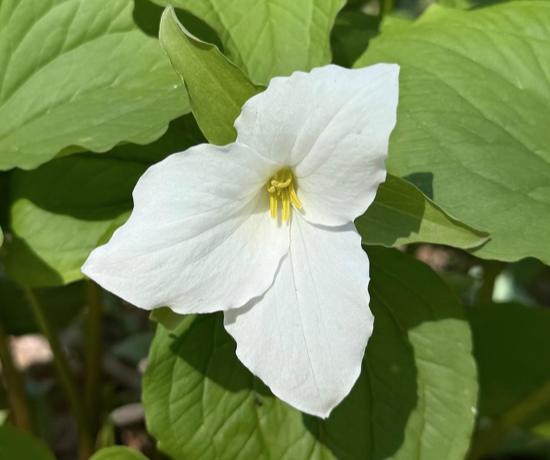
A little bush of white trilliums stood out along the path. Three large petals formed the triumvirate of the flower, a striking white against a green leafy background. There were also deep maroon Trillium recurvatum which I could really see why their other name is the bloody butcher. Light magenta Virgina Spring beauties were everywhere.
I felt a quiet thrill finding bloodroot. This small, unassuming green plant with a white flower has a complicated character. Its red sap is poisonous and can cause permanent scarring. Yet Native American healers worked with it as an emetic and respiratory aid and artists have used it as a natural dye.
Merrybells are bright yellow blossoms with long pointed tips at the end of their sepals that hang down towards the ground. The Menominee use this plant for swellings. The Potawatomi mix an infusion of the root with lard and use it as a salve to massage sore muscles and tendons. Bumblebees, mason and other bees feed from the nectar and collect pollen from the flowers. Deer love to eat these plants.
In the cathedral of spruce, among blood root and merrybells, and the songs of birds, I remember what I already knew: the land is the chief and what a gift that the Morton Arboretum has devoted itself to that sacred service for over a century.
Malama pono (take care of body, mind and heart),
June Kaililani Ryushin Tanoue
Kumu Hula, Roshi
P.S. Recent talks at our Zen Life & Meditation Center:
Ericka Mencken Trevino, "Mindfulness & Productivity Culture" https://youtu.be/bZ92N-bWn8k
Melanie Jessen, "Pranayama Breathwork to Enhance Your Meditation" https://youtu.be/dvV99Nt9qWc
June Tanoue, "Sacred Dance & the Bodhisattva Vow" https://youtu.be/CMP_DmpWgSE
June Tanoue, "Facing the Mountain" https://youtu.be/bW80BqnJFPw
Diane Bejcek "Nobody's Perfect" https://youtu.be/ffF82wWjFqA
Julie Kase "Basic Goodness" https://youtu.be/wUjgBy2CDTA