
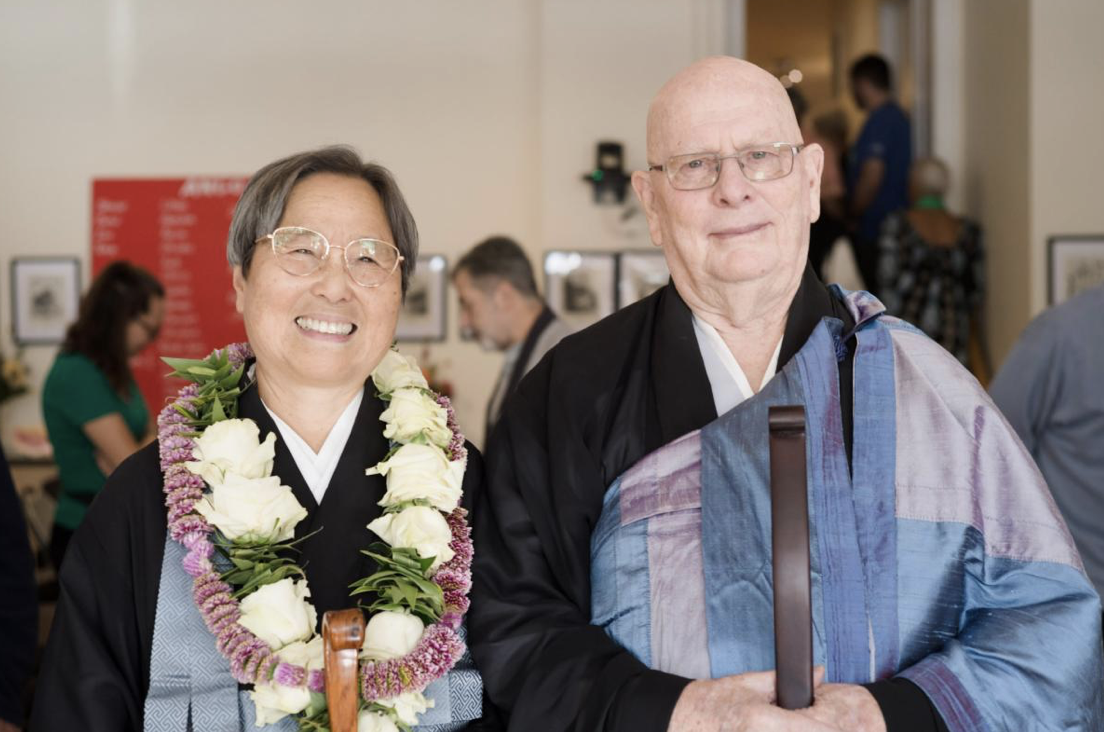
“The zendo is softened
By hula and zazen,
light dancing on the walls.”
Shinsan-Shiki – Ascending the Mountain Ceremony
October 25, 2026. Zen Life & Meditation Center’s Empty Sound Temple. On this day, in this place, I became Co-Abbot with Robert, 22 years after co-founding ZLMC. It is a milestone in the life of our Zen Center to have co-abbots who also happen to be its co-founders. And it is a milestone in our personal lives, as Robert and I approach our 39th year of marriage. After so many years of building this place side by side, I feel honored that we now hold it together this way too.
In Zen, there are ceremonies to mark important occasions, just as there are in Hula. I want to share some of what we did that day.
Robert led a procession of Zen teachers, priests, and mindfulness teachers from the community room into the zendo. We walked in silence, to the slow repeating sounds of an inkin bell and the beat of a Sufi drum. As we entered the zendo, I began chanting an oli to Laka, the deity of the forest, asking for protection and inspiration for all.
I wore my Zen Peacemaker okesa, carefully hand-stitched with fabric from people important to me: my family, my kumu, my laʻau lapaʻau teacher, and my friends. Wearing it, I felt all of them walking with me. Two cushions were laid before the main altar where Avalokiteshvara sits, and Robert and I each knelt on one.
I removed my okesa, placed a folded robe of rough brown linen-like cloth on my head, and with palms together chanted the Verse of the Kesa:
Vast is the robe of liberation
A formless field of benefaction
I wear the Tathagata teaching
Saving all sentient beings.
This robe was a favorite of Taizan Maezumi Roshi, founder of the White Plum Lineage and one of the first generation of Japanese Zen priests to come to America. He was Robert’s root teacher. Bernie Glassman gave the robe to me in 2014, when he and his wife Eve Marko came to serve as preceptors at my final empowerment as a Zen priest and teacher. It is a treasure in our sangha.
When I placed this robe on my head, I felt held by Maezumi Roshi, and by the whole long line of teachers who carried this practice forward so it could reach us here.
We bowed toward the altar three times, then rearranged the bowing cushions to face each other and made three bows. During the third bow with our foreheads on the cushions, we reached for each other’s hands, found them, and clasped them.
Part of my ceremonial work was to write a haiku for each of the seven altars in our center and to offer incense at each one. You can find them at the altars the next time you visit.
When I returned, my teacher and husband, Robert Joshin Althouse, read a proclamation naming me co-abbot. He handed me the long koa walking staff. I remember when this staff was made in Hawaiʻi for Robert’s final empowerment as a Zen teacher and priest. And now we share it.
Then I spoke. I remembered the peoples of the Council of Three Fires, the Potawatomi, Odawa, and Ojibwe, who first lived on the land where our Zen Center sits, and all my Zen, Hula, Laʻau Lapaʻau, and blood ancestors on whose shoulders I stand.
I shared that working with fear has been one of the greatest lessons Zen has taught me. From Auschwitz, to the intergenerational trauma of the Japanese American concentration camps during World War II, to ICE raids tearing apart Mexican and Latino families in our own neighborhoods today, it is good to face fear rather than turn away from it.
Though I didn’t say it that day, zazen has been deeply healing for me, as has hula. And then came Dharma Combat, which is quite a name for questions and answers that test one’s understanding.
One of my favorite moments came at the end of the ceremony, when seven of my hula students - Ruben, Alana, Gwen, Yukiko, Joy, Lorel, and Shar - joined me to dance “Make Strong.” Seeing five of them beside me and two dancing online, with such strength and heart, I felt once again that the hālau and the sangha are one family, simply practicing in different forms, with the same message of love and aloha.
That song, written by Hawane Rios and her mother Pua Case, was composed for the kiaʻi, the guardians of Mauna Kea. It is a call to stand up, forge through fear, and be steady guardians of the mountain. It asks us to remember the generations who came before us, the ancestors who lived on this land, and the wisdom that flows again and again from the heavens to the bedrock of the earth and back.
Shinsan-shiki means “ascending the mountain.” I believe that ascending the mountain is more than reaching the summit. It is about taking a stand to protect this place, this practice, and all who make it home.
Thank you to everyone who came, who danced, and all of you who held this day in your hearts. I am deeply grateful to walk this path with you.
Calling Protectors
of this place, earth, universe.
Boundless Gratitude
Mālama pono (take care of body, mind and heart),
June Kaililani Ryushin Tanoue
Kumu Hula, Roshi, Co-Abbot
P.S. Recently at our Zen Life & Meditation Center:
Shinsan-Shiki Ceremony https://youtu.be/nJTmljimVqo
Diane Bejcek: "Stages of the Spiritual Path - 10 Ox-herding Pictures" https://youtu.be/nJTmljimVqo
Barry Kaigen McMahon "Koans" https://youtu.be/GUed9LIn_Dg